Historic farm modernises irrigation system
SNAPSHOT
- A 2300ha farm in the historic village of Ross, Tasmania has introduced modern touches with a new irrigation system
- A cost-effective, flexible and reliable solution was required in order to access and pump water from a nearby river as well as take floodwater to top up on-farm storage
- Installation required sensitivity to protect the historical nature of the landscape and far as well as the ecological sustainability philosophy of the owners
As well as being a showcase of early convict and white settler history in Tasmania, the historic village of Ross, located in the Midlands of Tasmania, has a rich farming history.
Last year, the owners of a mixed-enterprise farm in the area were looking to introduce some modern touches by installing a new irrigation system that would access water from the nearby Macquarie River.
As part of this installation, a cost-effective, flexible and reliable solution was required to pump water from the river to supply centre pivot irrigators as well as to take floodwater to top up an on-farm storage.
The job required sensitivity, both to the historical nature of the landscape and farm, which included a contour drain built by convicts, and to the philosophy of the owners who emphasised their connection to the land, their animals and the local community and their commitment to ecological sustainability.
Major upgrade
Following the overall design and specification provided by the project consultant, Jason Woodham from Irrigation and Dairy Solutions procured and installed the pumps and infrastructure required for this project installation with assistance on the pump specifications provided by Neil McCarthy from Brown Brothers Engineers Australia.
The 2830 ha farm already had 1420 ha of irrigation consisting of six towable pivots that water 1300 ha and a fixed pivot that waters 120 ha. Irrigation was first installed on the farm in 1993 and upgrades have continued since.
In April last year, Irrigation & Dairy Solutions successfully tendered for a new system to be installed in two stages – two pivots covering 120 ha (completed in June 2020) followed by another two pivots covering 200 ha to be installed in stage 2. According to Jason, more additions are to follow as part of this major upgrade.
“The first crop for the new works, which are on an area that has not been cultivated before, will be medicinal poppies, followed by pasture for livestock,” said Jason, who added that there are about 10,000 sheep on the farm.
Water sources and pumps
The water sources for the irrigation systems are both the Macquarie River, which the farm has a long frontage to, and a storage dam on the adjoining 11,000 ha farm capable of holding up to 8,000 megalitres.
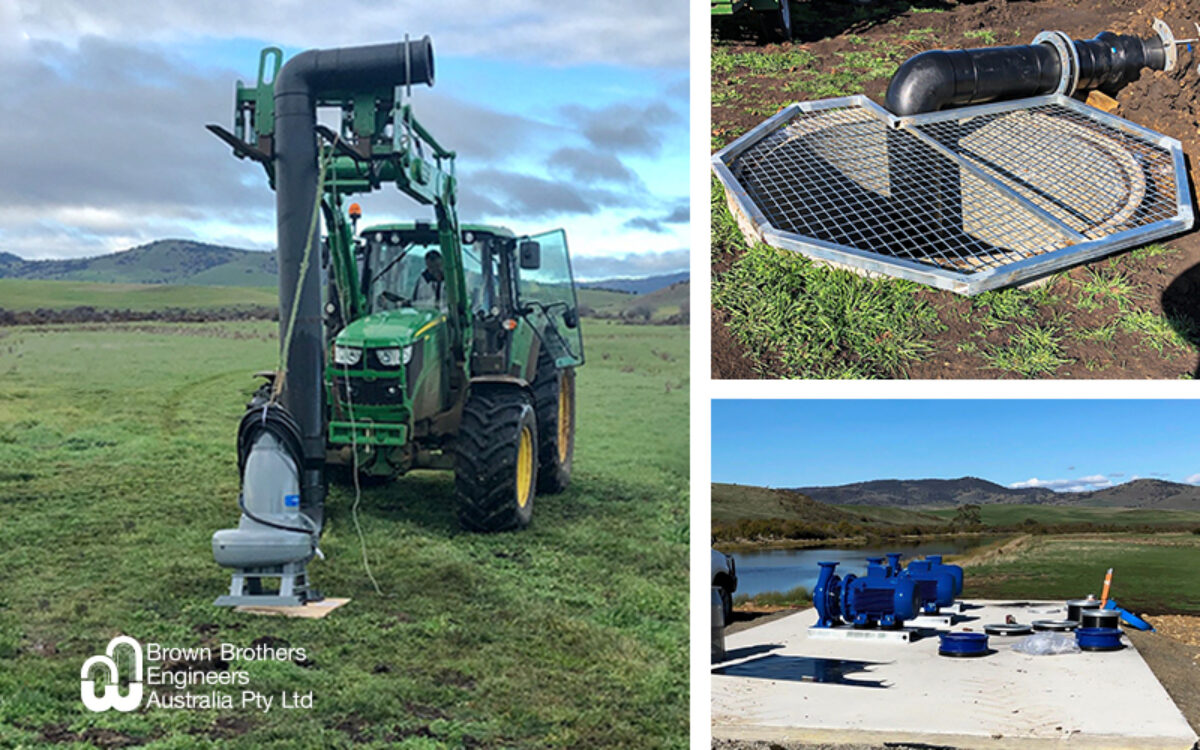
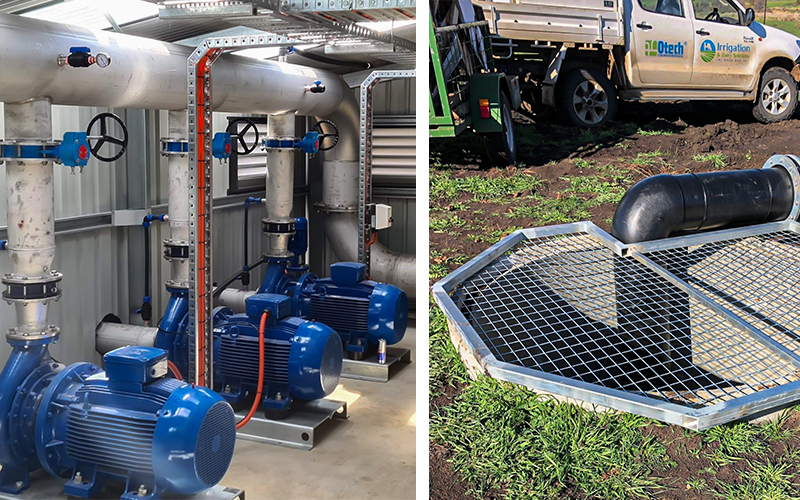
The pumps on the river are Goulds ISO end-suction pumps that deliver water straight to the two centre pivots while a Flygt submersible pump provides river water either to the storage dam or as part of their daily water right for usage. The stored water is then used to supply the centre pivots during the growing season.
The end suction specified pump type was selected by the project consultant, the pump builds were agreed upon by Jason in negotiation with Neil based on the requirements of the consultant. The Flygt submersible pump was specifically selected by Jason as it was a more efficient alternative to the original concept of a turbine style pump.
According to Jason, while access to the pump site was not difficult, there were the usual site-complicating issues when the pumps were being installed. The pumps are mounted 2m above natural ground height, a raised mound 14m x 7m x 2m high was formed and compacted with a ramp access at one end. The ground had to be compaction tested to be sure it could hold the weight of a 10.5 x 4.5 x .2m concrete slab with a 10m x 4m colour bond shed and the pumps.
All the pumps were mounted on a shared galvanised steel base and connected to a stainless-steel common discharge manifold
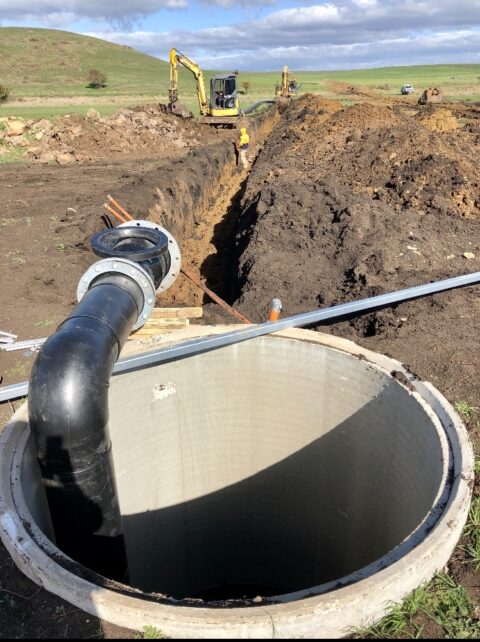
The contour drain was excavated through to install the new pipeline and the restored to its natural look
The Flygt pump line was cut to fit into the contour drain in the direction of the water flow and the bottom of the drain was rocked to stop erosion under water movement.
The pumps were started in mid-2020 and have been working without a hitch since. With this successful installation behind them, Neil and Jason are now working on the next stage in this historic farm’s irrigation modernisation process.
[Article originally appeared in the Irrigation Australia Journal]